Slotted timer Ngetok screw inserts mangrupakeun inserts threaded internal tur éksternal kalawan slot axial. Éta bisa ngaco kana liang pre-dibor pikeun ngabentuk threads internal-kakuatan tinggi ngaliwatan timer ngetok. Aranjeunna ngagabungkeun betah screwing dina "slotted cylindrical sirah Screws" jeung versatility tina "slotted screws". Taya pre-ngetok diperlukeun. Éta tiasa gancang ngalereskeun benang anu dilucuti atanapi langsung nyiptakeun benang tahan ngagem dina aluminium, plastik, sareng kai. Éta téh loba dipaké dina bagian palastik otomotif, housings éléktronik, sarta bindings ski.
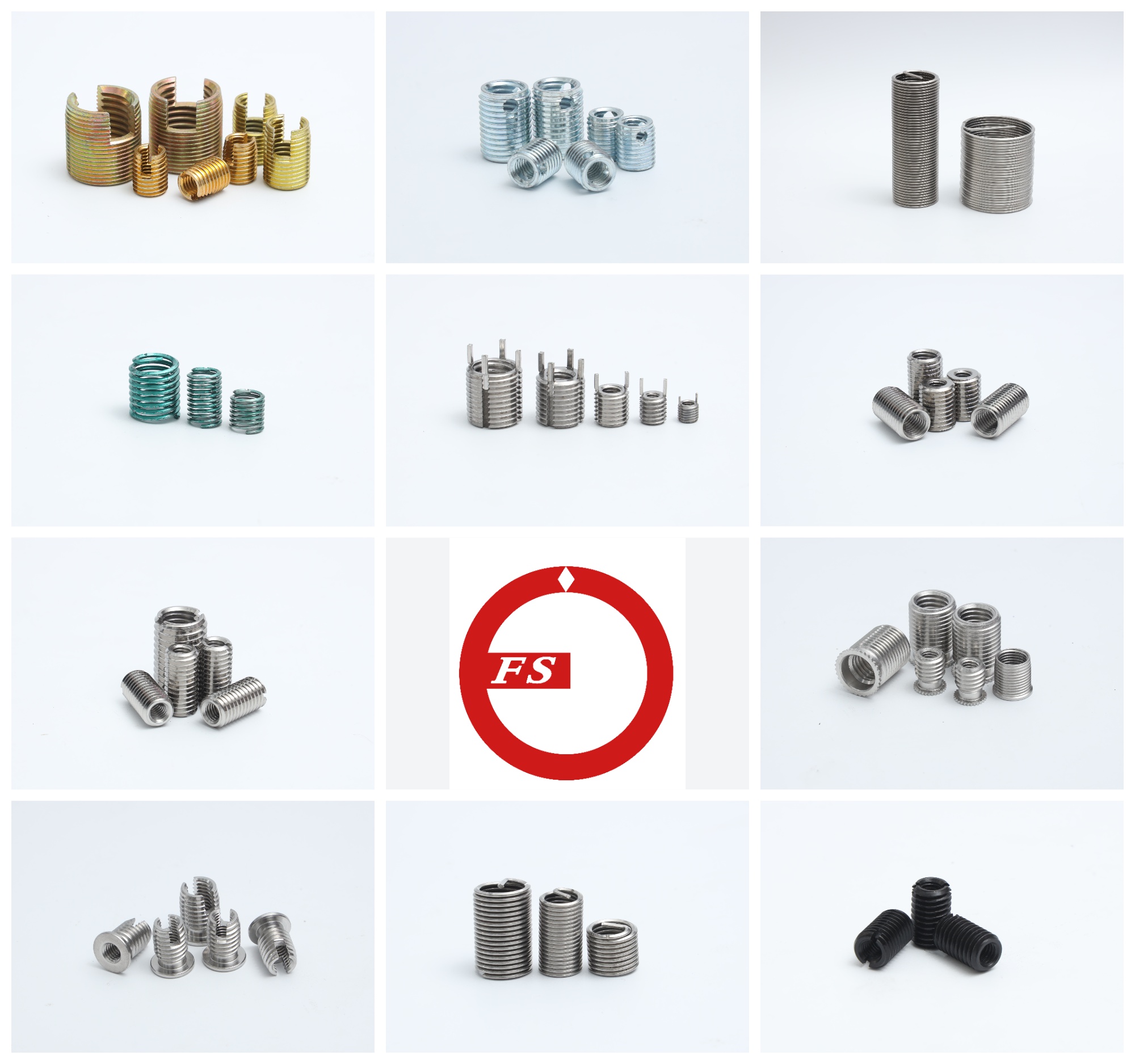
Wuxi Feisheng Hardware Products Co., Ltd. perenahna di kota Wuxi anu éndah, di sisi basisir Danau Taihu, dina Taman Industri Meicun Kacamatan Wuxi Xinwu. Ieu ngan 5-menit drive ti exit Wuxi East Expressway, ayana di jantung zona ékonomi Delta Walungan Yangtze, wewengkon dikaruniai sumberdaya alam jeung budaya luar biasa. Pausahaan ngahususkeun dina panalungtikan, pamekaran, produksi, penjualan, sareng jasa Sisipan benang kawat, sisipan benang ngetok diri, sareng alat anu aya hubunganana, sareng ayeuna mangrupikeun salah sahiji ti saeutik pabrik anu gaduh tilu jalur produksi sisipan benang.
Ti saprak ngadegna, perusahaan parantos komitmen pikeun nyumponan kabutuhan saleresna para palanggan sareng nyayogikeun aranjeunna kalayan sisipan benang kualitas pangluhurna. Urang taat kana kawijakan kualitas perbaikan kontinyu, mastikeun nuturkeun standar nasional, militer, jeung aerospace, sarta geus ngembangkeun standar jeung prosedur nguji produk urang sorangan.
Pikeun ningkatkeun kualitas produk sareng mastikeun stabilitas, perusahaan terus-terusan ngenalkeun téknologi sareng alat domestik sareng internasional anu canggih, ngahontal prosés produksi otomatis. Sapanjang sadaya prosés produksi, dina interval anu tos ditangtukeun, uji multi-tingkat dilaksanakeun nganggo alat ukur precision tinggi anu canggih. Urang pageuh yakin yén produk alus merlukeun perhatian meticulous kana detil dina unggal tahapan, mastikeun kinerja sarta kualitas unggal bets of inserts thread kalawan sumanget tukang, nyadiakeun konsumén jeung produk kelas munggaran tur terus ngaleuwihan ekspektasi maranéhanana.
Ngaliwatan usaha kontinyu ti tim Feisheng, inserts thread Feisheng geus loba dipaké dina aerospace, rail-speed tinggi, manufaktur mobil, generasi kakuatan, mesin, 5G, sarta mesin umum paeh casting. Khususna, perusahaan urang nangtung dina industri kendaraan énergi anyar; inserts thread kami dipaké dina loba kandaraan listrik di jalan kiwari. Tujuan kami dina widang sisipan benang nyaéta pikeun janten pamimPin dina industri sisipan benang Asia, produsén sisipan benang profésional, sareng pamimpin industri. Urang ngabagéakeun konsumén anyar jeung heubeul jeung babaturan nganjang ka pabrik urang pikeun hidayah jeung gawé babarengan!
Dina 2003, éta lulus ISO9001: 2000 sertifikasi sistem kualitas internasional
Dina 2018, éta lulus sertifikasi sistem manajemen kualitas ISO / TS16949
Sertifikasi sistem penerbangan di 2021
tambahkeun:F鞥er jalan 38# kuring i Jalan murni X di W u distrik W U ξ kota Propinsi Jiangsu
Fax: +86-510-83796863
Penjualan domestik merek: Ibu Yang +86-13815109735
Perdagangan Internasional: Tuan Liu +86-15961756595
Solusi sistem fastening: Bapak Li +86-13771186996
Situs Web: www.wxfslt.com
Surélék: wxlikenai@163.com
Telepon: 15961756595
Di dunya perakitan sareng manufaktur, kabutuhan nyiptakeun benang anu awét, tiasa dianggo deui dina bahan lemes atanapi rapuh parantos lami janten tangtangan. Inserts threaded geus mecenghul salaku solusi, sarta diantara aranjeunna, slotted timer ngetok screw sisipan nangtung kaluar pikeun betah pamakéan na, versatility, sarta pangabisa pikeun ngaronjatkeun integritas struktural produk countless. Ti interior otomotif ka éléktronika konsumén jeung jati, inserts ieu maénkeun peran kritis dina mastikeun yén screws tetep aman fastened, sanajan dina bahan nu disebutkeun bakal gagal dina stress terus-terusan.
At its core, a slotted self-tapping screw insert is a cylindrical component designed to be installed into a pre-drilled pilot hole in a host material (such as plastic, wood, or thin metal) to create a strong, permanent internal thread. Unlike traditional press-fit or heat-set inserts, this type features two key design elements: external self-tapping threads and longitudinal slots along its body.
The external self-tapping threads are engineered to cut into the host material as the insert is driven in, eliminating the need for pre-tapping the hole. This simplifies the installation process and reduces assembly time. The longitudinal slots—usually 2 to 4 in number, running from the top of the insert to near the bottom—allow the insert to compress slightly during installation. This flexibility is crucial: it reduces the risk of cracking the host material (especially in soft plastics or brittle woods) and ensures a tight, secure fit that resists loosening under vibration or load.
Internally, the insert features a standard thread (metric or imperial) that accepts a screw, and often a drive feature (like a slotted head or Hex Socket) to facilitate installation with a tool such as a screwdriver or Allen Wrench.
To understand why slotted self-tapping inserts are so effective, let’s break down their key design features and how they contribute to performance:
1. Slotted Body
The slots are not just a cosmetic detail—they are integral to the insert’s functionality. When the insert is driven into the pilot hole, the slots allow the external threads to bite into the host material while the insert’s body flexes. This flexibility distributes stress evenly across the host material, preventing localized cracking. For example, in a plastic dashboard component, the slots help the insert adapt to the plastic’s natural elasticity, ensuring a secure fit without damaging the part.
2. Self-Tapping External Threads
These threads are sharp and aggressive, designed to cut through the host material rather than relying on pre-formed threads. This feature is particularly useful in materials where pre-tapping is difficult or impossible (like thin metal sheets or composite materials). The self-tapping action creates a mechanical lock between the insert and the host, which is far stronger than a press-fit connection.
3. Material Options
Slotted self-tapping inserts are available in a range of materials to suit different applications:
Steel: Zinc-plated steel is a common choice for general-purpose applications, offering strength and corrosion resistance.
Stainless Steel: Ideal for outdoor or wet environments (like marine equipment or garden furniture) due to its superior rust resistance.
Brass: Used in electrical applications (brass is a good conductor) and for its non-magnetic properties, as well as corrosion resistance.
Aluminum: Lightweight and corrosion-resistant, making it suitable for aerospace or automotive applications where weight reduction is a priority.
4. Headed vs. Headless Designs
Headed inserts have a flange at one end that acts as a stop, preventing the insert from being driven too deep into the host material. This is useful for applications where a flush surface is not required, or where the flange provides additional stability. Headless inserts, on the other hand, are designed to sit flush with the host material’s surface, making them ideal for aesthetic applications (like furniture or consumer electronics) where a clean look is important.
Installing a slotted self-tapping insert is straightforward, but following the correct steps is essential to ensure optimal performance:
Step 1: Select the Right Insert and Pilot Hole Size
First, choose an insert that matches the internal thread size of the screw you plan to use, and the host material’s properties. Manufacturers provide detailed specifications, including the recommended pilot hole diameter. Using the wrong pilot hole size is a common mistake—too small, and you risk cracking the host material; too large, and the insert will not grip securely.
Step 2: Drill the Pilot Hole
Using a Drill Bit of the specified diameter, drill a pilot hole to a depth slightly greater than the insert’s length. This prevents the insert from bottoming out during installation, which could damage the host material or the insert.
Step 3: Drive the Insert
Using a tool that fits the insert’s drive feature (e.g., a slotted screwdriver for a slotted insert), align the insert with the pilot hole and apply steady, even torque. The self-tapping threads will cut into the host material, and the slots will allow the insert to flex and create a tight fit. Be careful not to over-torque—this can damage the host material or strip the insert’s threads.
Step 4: Verify the Installation
After installation, check that the insert is seated correctly (flush for headless inserts, or the flange is in contact with the surface for headed inserts). Test the internal thread by screwing in the desired fastener to ensure it fits smoothly and securely.
Slotted self-tapping inserts are used in almost every industry where strong, reusable threads are needed. Here are some key applications:
In automotive manufacturing, these inserts are widely used in plastic components like interior panels, door handles, and dashboard parts. For example, a plastic door panel might use an insert to mount a speaker—this ensures that the speaker’s screws do not strip the plastic threads over time, even with repeated removal for maintenance.
In devices like laptops, smartphones, and printers, slotted self-tapping inserts are used to secure components like batteries, motherboards, and casings. For instance, a laptop’s plastic base might use these inserts to hold the screws that attach the hard drive—this prevents the screws from pulling out when the hard drive is replaced.
Wooden furniture often relies on these inserts to create durable threads. For example, a wooden cabinet door might use a brass insert to attach the hinge—this ensures that the hinge remains securely fastened, even with frequent opening and closing.
In aerospace applications, lightweight materials like aluminum and composites require inserts that can handle high loads without adding weight. Slotted self-tapping inserts made from aluminum or titanium are ideal here—they provide strong threads while keeping the overall weight of the component low.
In medical equipment like surgical tools and diagnostic devices, these inserts are used in plastic or metal housings. For example, a plastic casing for a blood glucose monitor might use stainless steel inserts to hold the screws that keep the device closed—this ensures the device remains sterile and secure.
Slotted self-tapping inserts offer several advantages over other types of inserts:
1. Ease of Installation: No pre-tapping required, which saves time and reduces assembly costs.
2. Versatility: Can be used in a wide range of materials (plastic, wood, metal, composites).
3. Strong Grip: The self-tapping threads and slotted design create a tight, vibration-resistant fit.
4. Reusability: The internal thread can be used repeatedly without stripping, making it ideal for components that require frequent disassembly.
5. Cost-Effective: Compared to heat-set or press-fit inserts, these are often cheaper and easier to install, making them a popular choice for mass production.
The future of slotted self-tapping inserts is focused on miniaturization, sustainability, and smart technology:
Miniaturization: As devices become smaller (like wearables and micro-electronics), inserts are being designed in tiny sizes to fit into compact components.
Sustainability: Manufacturers are developing inserts made from recycled materials (e.g., recycled steel) to reduce environmental impact.
Smart Inserts: Inserts with integrated sensors are being developed to monitor thread tightness and detect damage, which is useful in critical applications like aerospace and automotive.
Slotted self-tapping screw inserts are a small but essential component in modern manufacturing. Their unique design—combining self-tapping threads and slotted bodies—solves the problem of weak threads in soft or fragile materials, enhancing the durability and reliability of countless products. Whether in a car’s dashboard, a laptop’s casing, or a wooden cabinet, these inserts play a crucial role in ensuring that components remain securely fastened, even under repeated stress. As technology advances, we can expect to see even more innovative uses for these versatile inserts, making them an integral part of manufacturing for years to come.

 English
 Español
 Portugues
 Pусский
 Français
 Deutsch
 日本語
 한국어
 العربية
 Italiano
 Nederlands
 Ελληνικά
 Svenska
 Polski
 ไทย
 Türk dili
 हिन्दी
 Indonesia
 Melayu
 Tiếng Việt
 中文
 dansk
 Magyar
 қазақ
 বাংলা
 עִברִית
 čeština
 Soomaali
 မြန်မာ
 فارسی
 українська
 norsk
 Gaeilge
 беларускі
 Română
 ພາສາລາວ
 Filipino
 lietuvių
 Cymraeg
 македонски
 Suomalainen
 slovenský
 o'zbek
 اردو
 հայերեն
 Igbo
 български
 سنڌي
 Shona
 සිංහල
 Hrvatski
 íslenskur
 galego
 català
 Zulu South Africa
 Afrikaans isiXhosa
 ಕನ್ನಡ
 lëtzebuergesch
 basa jawa
 Кыргызча
 тоҷикӣ
 Србија
 Twi
 Hawaii
 Cebu
 नेपाल
 euskara
 frissi
 יידיש
 latvija
 slovenija
 kiswahili
 ਪੰਜਾਬ
 پښتو
 საქართველოს
 hua moni
 bosna
 Kreyòl ayisyen
 Eesti
 Gàidhlig na h-Alba
 Samoa
 Монгол
 Azərbaycan
 አማራ
 Shqipëria
 Malagasy
 Malta
 ខ្មែរ
 Chicheva
 中文(繁体)
 ଓଡିଆ
 Setswana
 Afrikaans
 Aymara
 Башҡорт
 Türkmenler
 ትግሪኛ
 Afaan Oromoo
 অসমীয়া
 Kinyarwanda
 Ilocano
 Wolof
 अवधी
 Oluganda
 Bikol
 Fulɓe
 Kikongo
 Sango
 ދިވެހި
 Lingala
 मैथिली
 Tsonga
 ꯃꯦꯏ ꯊꯥꯏ꯫
 brezhoneg
 Furlan
 नेवा
 རྫོང་ཁ
 Santali
 Аҧсуа
 Нохчийн
 Чӑваш
 Татар
 Batak Karo
 دری
 Diura
 Fengyu
 Eʋegbe
 Iban
 Fiji
 Tonga
 Inuktitut
 Nahuatl
 maaya yucatec
 Runasimi
 guarani
 Qafar
 Acholi
 Dinka
 Luo
 Lundi
 isiNdebele
 Tshivenḓa
 Sesotho sa Leboa
 Sesotho sa Borwa
 Ndumbe
 Papuan Pidgin
 Rromani ćhib
 Thok Nath
 Pilarian



 Telepon